

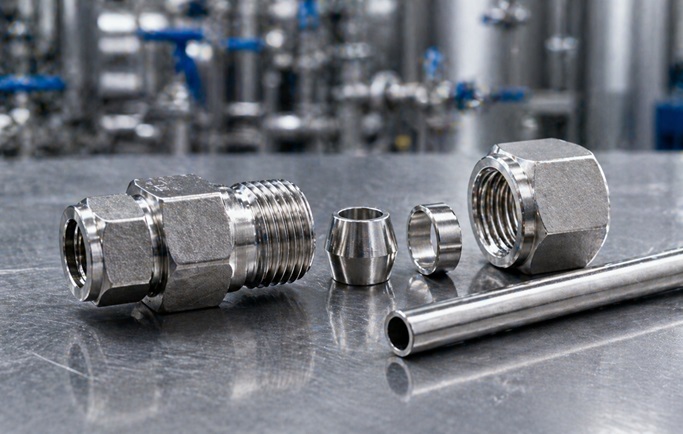
The quick version: Stainless steel compression fittings create leak-proof connections without welding, soldering, or specialist qualifications — making them the standard choice for instrumentation, oil and gas, pharmaceutical, and high-pressure industrial applications. This article explains how compression fittings work, what separates quality products from substandard ones, and what to look for when specifying stainless steel compression tube fittings for critical systems.
A single leaking fitting in a process system can halt production, compromise product quality, or create a safety incident. In industries where the media being transported includes hazardous gases, high-pressure fluids, or pharmaceutical-grade substances, the reliability of every connection is a non-negotiable requirement.
Stainless steel compression fittings have become the standard across Australia’s most demanding industrial sectors — oil and gas, petrochemical, pharmaceutical, food and beverage, mining, and power generation — precisely because they deliver consistent, verifiable, leak-proof connections without the complexity and risk of welding.
This article covers how compression fittings work, what differentiates quality products from poor ones, and the practical considerations for specifying and installing stainless steel compression tube fittings on your next project.
How stainless steel compression fittings actually work
Compression fittings create a seal by mechanically compressing components around the tube. The three core elements are the fitting body, the nut, and the ferrule — or ferrules, in the case of twin-ferrule designs.
When the nut is tightened, it drives the ferrule against the tube and the fitting body simultaneously. The ferrule deforms slightly under compression, biting into the outer surface of the tube and creating a gas-tight, liquid-tight mechanical seal. The seal relies on the physical interaction between the ferrule and the tube rather than any sealant compound, which is why fitting and tube material compatibility matter.
Twin-ferrule systems, where two ferrules work together with the front ferrule sealing and the back ferrule providing grip and preventing tube withdrawal, offer a more secure and repeatable connection than single-ferrule designs. For instrumentation and critical process applications, twin-ferrule stainless steel compression fittings are the industry standard.
The challenge with traditional compression fittings has always been knowing when you’ve tightened enough. Under-tightening produces a fitting that leaks. Over-tightening damages the ferrule and the tube, compromising the joint. This is the problem that well-designed products solve — and where quality separates quickly from the competition.
What makes a quality compression fitting
Not all compression fittings perform equally. The differences that matter in practice come down to material grade, dimensional consistency, and installation assurance.
Material grade
For industrial and instrumentation applications, 316/316L stainless steel is the standard. Its higher molybdenum content gives it superior resistance to pitting and crevice corrosion compared to 304 stainless — which matters in environments involving chlorides, acids, or aggressive process media. Fittings made from lower-grade materials may meet dimensional specifications initially but fail prematurely under the conditions of real industrial use.
For the tube used with compression fittings, fully annealed seamless or welded tubing meeting ASTM A269 or ASTM A213 specifications is the correct specification. Tube hardness matters: a maximum of HRB 90 on the Rockwell scale is the standard requirement, with HRB 80 preferred for bending applications. The hardness differential between the ferrule and the tube is what drives proper ferrule bite and seating — use tube that’s too hard and the ferrule won’t bite correctly.
Dimensional consistency
Compression fittings only work reliably when the ferrule, nut, and body are manufactured to close tolerances consistently. Manufacturing variation that allows the ferrule to seat unevenly produces joints that may pass an initial pressure test but fail under repeated thermal cycling or vibration — common conditions in industrial environments.
Installation assurance
The most significant advancement in stainless steel compression tube fittings design in recent years is the introduction of visual tightening indicators. Systems that include a check ring or similar mechanism give the installer a clear, physical signal that the correct tightening position has been reached — eliminating the guesswork that leads to under-tightened or over-tightened joints.
This matters particularly in environments where fittings are installed by workers who may not be experienced instrumentation specialists. A visual indicator turns a skill-dependent task into a repeatable process, reducing installation errors and the callbacks and downtime that follow them.
Industry applications for stainless steel compression fittings
The breadth of industries that rely on stainless steel compression fittings reflects their versatility. Quality twin-ferrule fittings are tested and qualified for use in conditions as demanding as cryogenic temperatures, high-vacuum applications, and elevated pressures — making them suitable for most instrumentation and process piping requirements.
Oil and gas and petrochemical
In oil and gas, fitting reliability is a safety-critical matter. Compression fittings used in this sector must comply with NACE MR0175/ISO 15156 for hydrogen sulphide environments and ASME B31.3 for process piping. Pressure ratings range from 1,200 psi up to 8,100 psi and beyond depending on tube OD and wall thickness, covering the full range of upstream and downstream applications.
Pharmaceutical and food and beverage
Hygienic applications demand fittings with smooth internal profiles that don’t harbour bacteria or product residue, and materials that won’t contaminate the media being transported. Stainless steel compression fittings meet these requirements, provided tube and fitting materials are correctly specified for the cleaning and sterilisation media used in the facility.
Mining and resources
Mining environments are tough on equipment. Dust, vibration, chemical exposure, and temperature extremes create conditions that lower-quality fittings simply don’t survive. For instrumentation and process lines in mining applications, the combination of 316 stainless construction and twin-ferrule design provides the corrosion resistance and mechanical grip needed to maintain reliable connections in the field.
Industrial gases and hydrogen systems
As Australia’s hydrogen industry develops, demand for fittings qualified for hydrogen service is increasing. Quality compression fittings tested in vacuum and cryogenic conditions — and specifically validated for hydrogen systems — are available and in active use in energy and power generation applications nationally.
Interchangeability and compatibility
A practical concern for maintenance and procurement teams managing existing installations is whether replacement fittings need to match the original brand exactly, or whether genuine interchangeability exists across manufacturers.
Quality compression fittings are designed and manufactured to be dimensionally interchangeable with other industry-leading brands. Where formal interchangeability confirmation is required — as it often is in regulated applications — third-party compatibility testing can be conducted and reports provided. This gives project teams the flexibility to source from a preferred supplier without being locked to a single brand for the life of the installation.
Frequently asked questions
Are stainless steel compression fittings suitable for gas applications?
Yes, provided they are correctly rated and specified for the gas application in question. Natural gas, industrial gases, and hydrogen each have specific considerations around material compatibility, pressure rating, and applicable standards. Always confirm the fitting’s certification and pressure rating for the specific gas application before installation.
What tube specifications should I use with stainless steel compression tube fittings?
Quality fittings require fully annealed seamless or welded tube meeting ASTM A269 or ASTM A213 specifications. The tube must not exceed a maximum hardness of HRB 90 on the Rockwell scale, with HRB 80 preferred for applications involving bending or flaring. Using the correct tube specification is essential for reliable ferrule seating and long-term joint integrity.
How do I know when a compression fitting is correctly tightened?
With standard fittings, correct tightening is determined by a specified number of turns past finger-tight — typically one and a quarter turns. With fittings that include a visual indicator such as a check ring, you tighten until the indicator releases, providing a clear repeatable signal that the correct tightening position has been reached. This removes subjectivity from the installation process and significantly reduces the risk of under or over-tightening.
Can stainless steel compression fittings be reused after disassembly?
Twin-ferrule stainless steel compression fittings can typically be reassembled after disassembly provided the tube end is undamaged. Reassembly requires only a small fraction of a turn past finger-tight, as the ferrule has already been set during initial assembly. In critical applications, some operators choose to use fresh tube ends for reassembly to ensure optimal joint integrity.
Looking for reliable stainless steel compression fittings for your next project? Speak with a technical specialist to confirm the right product and specification for your application